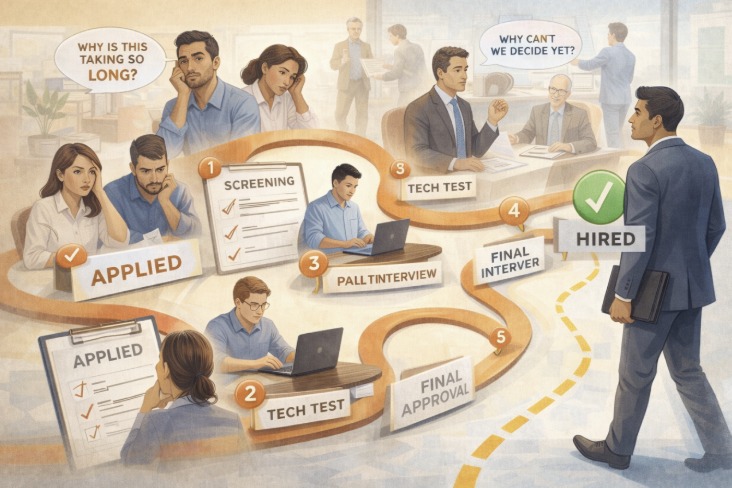
One of the most common frustrations candidates share is simple:
“Why does hiring take so many steps?”
From screenings, technical tests, panel interviews, to final approvals, the process can feel endless. Some candidates see it as inefficiency. Some hiring managers see it as necessary caution.
The truth sits somewhere in between.
Hiring Is a High-Stakes Decision, Not a Quick Transaction
Hiring is one of the few decisions that directly affects revenue, team performance, and company culture. A wrong hire can be costly, not just financially, but emotionally and operationally.
That is why companies often design multiple stages: to reduce uncertainty, align stakeholders, and ensure the decision is defensible.
From the outside, it looks slow. From the inside, it often feels risky to move too fast.
Multiple Stakeholders Mean Multiple Perspectives
Recruitment is rarely driven by one person. Hiring managers, HR, leadership, and sometimes regional teams all need visibility.
Each stage usually exists because someone needs clarity on a different dimension:
skills, culture fit, leadership style, technical depth, or business alignment.
The challenge is not that stages exist. The challenge is when stages multiply without clear purpose.
Process Length Often Reflects Organizational Maturity
Interestingly, long recruitment processes are not always a sign of bureaucracy. Sometimes they reflect growth, restructuring, or risk management.
But in other cases, they reveal unclear decision-making, overlapping responsibilities, or internal hesitation.
Candidates experience the delay. Companies experience the uncertainty. Both sides feel the friction.
Speed vs Quality: The False Trade-Off
Many companies believe they must choose between hiring fast or hiring right. In reality, structured and focused processes can be both fast and high-quality.
The difference is clarity:
- Clear role definition
- Aligned decision-makers
- Structured evaluation criteria
- Decisive timelines
When these exist, fewer stages are needed, and decisions happen faster.
Where Headhunters Add Real Value
This is where experienced headhunters quietly streamline the process. They pre-qualify candidates, align expectations early, and act as a bridge between business needs and talent reality.
By the time a candidate reaches the hiring manager, the process becomes about confirmation, not exploration. Fewer surprises, fewer unnecessary stages, faster decisions.
Final Thought
Recruitment feels long not because companies want it to be complicated, but because hiring is one of the most irreversible business decisions.
The goal is not fewer steps. The goal is fewer unnecessary steps. Because in hiring, clarity is what truly accelerates speed.