
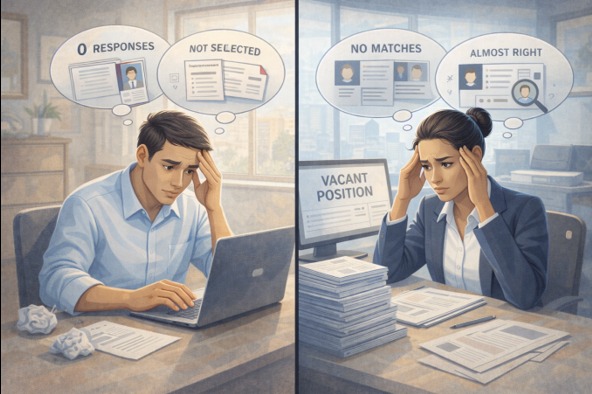
Scroll LinkedIn long enough and you will see two very different frustrations.
Job seekers talk about unanswered applications, endless interviews, and silence after follow-ups. Recruiters talk about roles staying open for months, candidates dropping out, and “almost right” profiles that never fully fit.
From the outside, it sounds contradictory. If so many people are looking for jobs, why is hiring still so hard?
The reality is more nuanced than it looks.
Both Sides are Experiencing the Same Market from Opposite Angles
For candidates, the market feels crowded. One role can receive hundreds of applications within days. Even strong profiles can disappear into the system without feedback.
For recruiters, volume does not equal suitability. A large pipeline often hides a smaller truth: only a fraction of applicants meet the core requirements, timing, budget, and expectations of the role.
Both sides feel overwhelmed, just in different ways.
“Available” Does Not Always Mean “Hireable”
Many candidates are actively applying, but availability alone is not what companies are hiring for.
Recruiters look at a combination of factors at the same time:
- Skill depth, not just keywords
- Relevant experience, not adjacent exposure
- Salary alignment
- Notice period and start-date feasibility
- Motivation for the move
A candidate can be strong in one area and misaligned in another. When that happens repeatedly, roles stay open even with many applications coming in.
Hiring Is Not Only About Skills
From the candidate’s perspective, “I can do the job” feels like the most important argument.
From the recruiter’s perspective, the question is broader: Can this person succeed here, now, with this team, under this manager, at this stage of the business?
Culture fit, communication style, adaptability, and timing often matter just as much as technical capability. These factors are harder to see on a CV, which is why interviews sometimes feel long and repetitive.
Why the Process Feels Slow and Unfair
Candidates experience delays as rejection or lack of respect. Recruiters experience delays as coordination complexity.
Behind one hiring decision are multiple moving parts: hiring managers, internal approvals, budget confirmations, team alignment, and sometimes changing priorities. Even when a recruiter wants to move fast, the system does not always allow it.
That gap between intention and execution creates frustration on both sides.
Misalignment Creates Noise, Not Outcomes
Many hiring challenges come down to misalignment rather than lack of opportunity.
Candidates apply broadly to increase chances. Recruiters screen narrowly to reduce risk. The result is a noisy middle where effort is high, but progress feels slow.
When expectations, readiness, and context do not line up, both sides walk away feeling disappointed, even though neither is “wrong.”
The Shared Reality No One Talks About
Job seekers are not imagining how hard it is to get hired. Recruiters are not exaggerating how hard it is to hire well.
Both are operating in a market where precision matters more than volume, and timing matters more than intent.
Final Thought
This is not a competition of who has it harder. It is a reminder that hiring is a matching process, not a transaction. When the match is right, things move surprisingly fast. When it is not, no amount of applications or interviews can force alignment.
Understanding that reality does not remove the frustration, but it explains why both sides are struggling at the same time.