
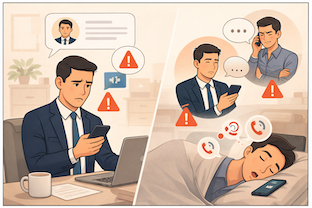
There are also moments in recruitment where the interaction takes a different direction.
A candidate applies and is invited to continue, but does not respond. Another agrees to an interview, but does not show up. Some engage in the process, but communicate in a way that feels overly rigid or focused only on their own expectations, without much openness to discussion.
At that point, the process simply moves on, and attention shifts to other candidates. And from the outside, it may seem like nothing significant has happened.
What Often Goes Unseen
In recruitment, interactions are rarely treated as isolated moments.
Beyond what is visible in a CV, how a process unfolds is often documented as part of a broader evaluation. Notes, observations, and communication patterns are commonly captured to support consistency across different searches.
This is not about judging candidates, but about maintaining clarity in a process that involves multiple roles, stakeholders, and decisions.
As a result, interactions become part of a structured context that can be revisited when needed.
The Assumption of a Clean Slate
It is understandable that some candidates may assume each opportunity starts fresh.
From their perspective, a new role means a new evaluation. However, in practice, previous interactions are often still accessible, especially in environments where recruitment processes are managed systematically.
This does not automatically close doors. But it does mean that earlier impressions can influence how the next conversation is approached.
A Matter of Professional Consistency
From a recruiter’s perspective, consistency reduces uncertainty.
Candidates who communicate clearly and follow through tend to create a sense of reliability. On the other hand, when interactions become inconsistent, whether through lack of response, missed commitments, or misaligned communication, it introduces questions that may need to be reconsidered before moving forward.
In more focused or high-stakes searches, this context can quietly shape how decisions are made.
Final Thought
From a recruiter’s lens, interactions are not only experienced in the moment. They are often recorded, revisited, and understood as part of a larger picture.
And in a process that is both human and structured, how someone engages can influence more than just the outcome of a single opportunity.