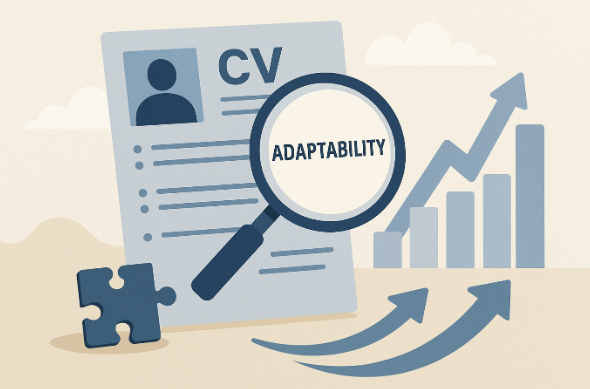
In today’s volatile business environment, hiring only for hard skills is no longer enough. The half-life of skills is shrinking—McKinsey estimates that nearly 50% of the skills we value today will no longer be relevant by 2030. That means the true differentiator for organizations isn’t just technical expertise, but adaptability: the ability to learn, unlearn, and evolve as circumstances change.
Why Adaptability Matters More Than Ever
The last few years have shown us how fast markets can shift. Entire industries have been disrupted by technology, consumer behavior, or global events. Think about once-dominant companies like Nokia or Kodak, which had highly skilled workforces but failed to adapt quickly enough. Now compare that to Netflix or Grab, which thrived by continuously evolving their people and strategies. The difference wasn’t skill—it was adaptability.
How Adaptability Shows Up in the Workplace
Adaptability isn’t a vague soft skill. It reveals itself in tangible ways:
- Employees who volunteer for projects outside their scope.
- Team members who ask “what’s next?” instead of “why me?” when faced with change.
- Professionals who stay calm when KPIs shift or priorities are reset overnight.
- Individuals who embrace ambiguity and use it as a springboard for innovation.
These are the traits that help organizations not just survive uncertainty but turn it into opportunity.
Why Leaders Must Rethink Hiring Criteria
Too often, job descriptions remain rigid checklists. But in dynamic markets, roles evolve faster than the ink dries on the JD. Hiring managers and HR leaders who focus solely on today’s requirements risk building teams that are outdated tomorrow. By widening the criteria to include learning agility, resilience, and openness to change, leaders can future-proof their organizations.
How to Hire for Adaptability
Assessing adaptability takes intentional effort:
- Ask candidates about their biggest professional failure and how they recovered.
- Simulate real-life changes in assessments—shifting priorities mid-task, for example—to see how they react.
- Value diverse career trajectories. Candidates who’ve moved across industries, functions, or even career breaks often bring adaptability that linear resumes don’t.
The Strategic Advantage
For executives and HR leaders, the message is clear: the biggest hiring risk isn’t bringing someone slightly underqualified on board—it’s hiring someone who can’t evolve when the market demands it. By making adaptability a core hiring lens, organizations can build resilience-based teams capable of thriving in uncertainty.