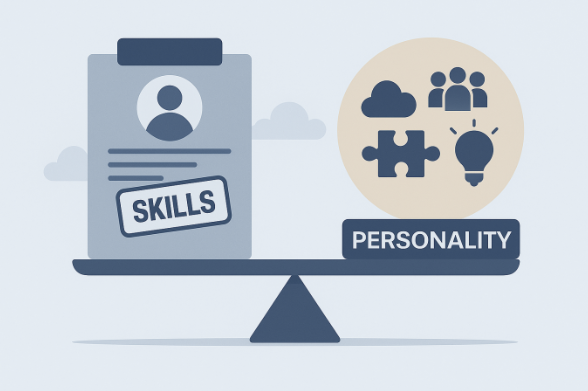
“Skills expire. Personality endures.”
In today’s business landscape, adaptability is no longer optional. Markets shift faster than planning cycles, technologies disrupt entire industries overnight, and customer expectations evolve at a relentless pace. Hard skills, once considered the most reliable predictor of success, are increasingly short-lived. What endures, and often determines who thrives in uncertainty, is personality.
The Rising Value of Adaptability
Most leaders acknowledge the importance of skills when hiring, but fewer recognize that skills are a moving target. What a team mastered last year may already be outdated today. In contrast, adaptability, the ability to stay effective amid change, becomes the anchor.
Organizations that fail to prioritize adaptability often discover too late that their most technically precise teams struggle to pivot when the market demands it. The result is not just stalled execution but also a costly erosion of momentum.
Personality Traits That Drive Adaptability
Adaptability is not random, it has roots in personality. The individuals who thrive in ambiguous, shifting environments often share key traits:
- Curiosity: A natural drive to explore beyond job descriptions and learn continuously.
- Resilience: The ability to rebound quickly from setbacks and maintain stability in times of uncertainty.
- Openness: A willingness to embrace ideas that challenge personal comfort zones or established practices.
- Humility: The capacity to admit what one does not know, and to learn from others without ego.
These traits cannot be captured in a list of technical proficiencies, but they quietly define who sustains performance when strategies change.
When Personality Becomes a Competitive Advantage
The impact of personality-driven adaptability is most visible during periods of transformation such as market expansions, digital pivots, or restructuring. Teams with adaptable individuals are quicker to reset, re-align, and re-execute. They are less resistant to change, more collaborative across silos, and more effective in environments where the plan is a moving target.
In fast-moving markets, the companies that win are not necessarily those with the most skilled teams, but those with the most adaptable ones.
Hiring Beyond Skills
Traditional hiring models over-index on technical match. Candidates are evaluated on what they have done, not how they respond to what they have not yet faced. This creates a dangerous blind spot.
Forward-thinking recruitment requires shifting the lens. Instead of only asking, “Can they do this job today?”, leaders must also ask, “Will they still be relevant tomorrow?”
That is where recruiters and headhunters bring unique value, by probing for signals of adaptability through behavioral interviews, career trajectories, and reference insights. The expertise lies not only in matching resumes, but in reading between the lines, identifying the personalities that can thrive in evolving roles.
Final Thought
Resumes show history. Personality signals the future.
“Hire for skills, and you may solve today. Hire for adaptability, and you future-proof tomorrow.”